MUX8
Function - Select one of the inputs - 8 inputs.
Inputs
|
Input |
Data type |
Description |
|
K |
DINT |
Selection command. |
|
IN0 |
ANY |
First input. |
|
IN1 |
ANY |
Second input. |
|
IN2 |
ANY |
Third input. |
|
IN3 |
ANY |
Fourth input. |
|
IN4 |
ANY |
Fifth input. |
|
IN5 |
ANY |
Sixt input. |
|
IN6 |
ANY |
Seventh input. |
|
IN7 |
ANY |
Last input. |
Outputs
|
Output |
Data type |
Description |
|
Q |
ANY |
IN0 or IN1 ... or IN7 depending on K (see truth table). |
Truth table
|
K |
Q |
|
0 |
IN0 |
|
1 |
IN1 |
|
2 |
IN2 |
|
3 |
IN3 |
|
4 |
IN4 |
|
5 |
IN5 |
|
6 |
IN6 |
|
7 |
IN7 |
|
other |
0 |
Remarks
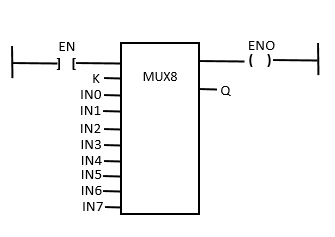
In LD language, the input rung (EN) enables the selection. The output rung keeps the same state as the input rung.
ST Language
Q := MUX8 (K, IN0, IN1, IN2, IN3, IN4, IN5, IN6, IN7);
FBD Language
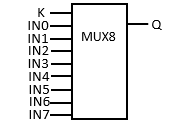
LD Language
The selection is performed only if EN is TRUE.
ENO has the same value as EN.

MUX8 |
|
IEC 61131-3 Automation platform > Programming - Reference guide > Selectors > MUX8 |
|
|


Created with the Personal Edition of HelpNDoc: Free Kindle producer